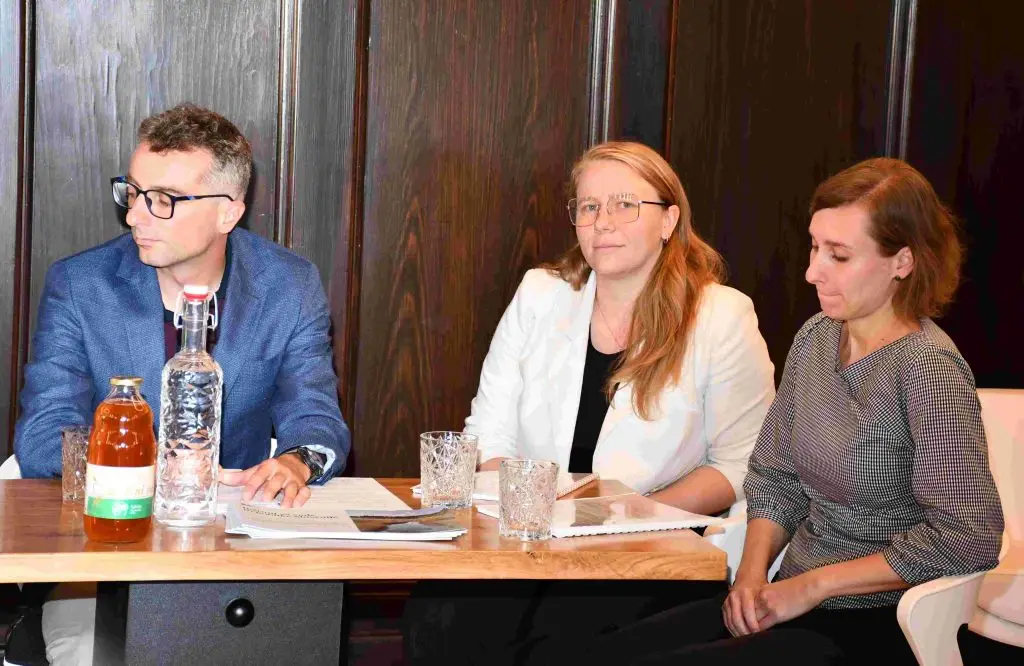
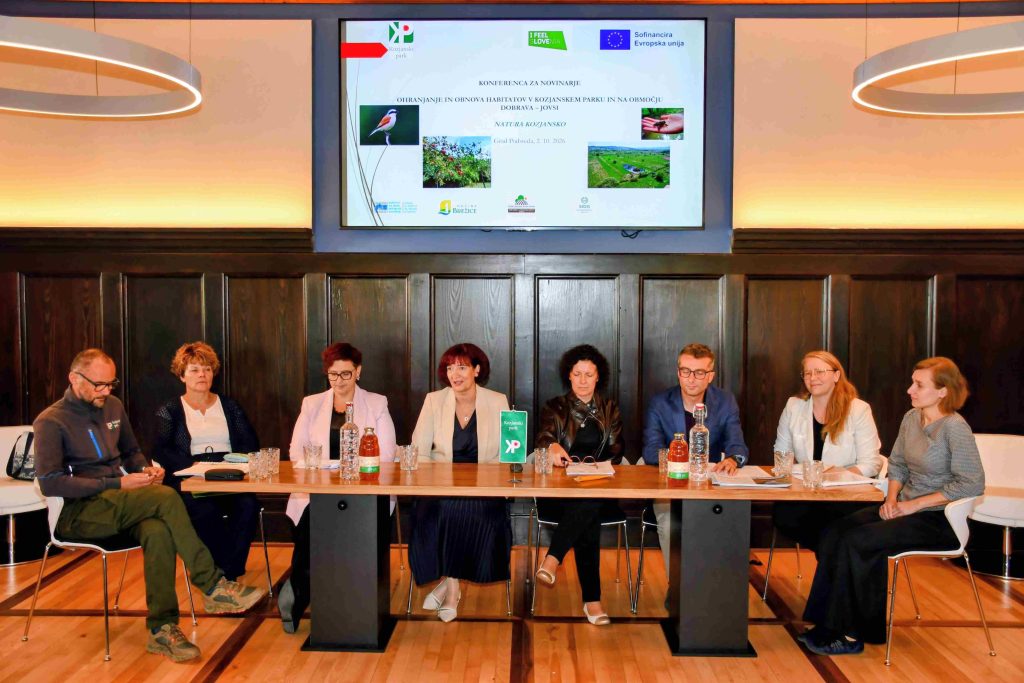
On 2 October 2026, the Institute for Water of the Republic of Slovenia (IzVRS) attended a press conference at Podsreda Castle for the project Conservation and Restoration of Habitats in Kozjansko Park and the Dobrava – Jovsi Area, known by its short name Natura Kozjansko. Matej Šurk, the project leader at IzVRS, presented the Institute’s planned activities to improve habitats in the Natura 2000 sites Dobrava – Jovsi and Sotla with Tributaries.
In the project, IzVRS addresses the objectives of good water status while contributing to three conservation objectives: improving living conditions for the yellow-bellied toad and the European pond turtle, and improving the condition of the habitat type natural eutrophic lakes with typical aquatic vegetation.
In the Dobrava – Jovsi area, we will restore a water body on the Črni potok stream in the western part of Dobrava, which was artificially created in the past, to benefit the yellow-bellied toad. The measures will improve the hydrological conditions and habitat quality for this species and other key amphibian species.
For the European pond turtle, we will establish meadow and other non-forest areas suitable for nesting along the Šica stream and the overgrown račjek pond. We will remove excess vegetation that blocks access to nesting sites and reduces sun exposure of the ground, and create gentler banks to make it easier for turtles to leave the water. The pond turtle habitat will also be improved at Slogonsko, on an oxbow lake of the Sotla River.
In the Sotla with Tributaries area, we will restore a selected oxbow lake in Kunšperk in the Municipality of Bistrica ob Sotli. The planned measures include deepening, removal of invasive alien species, planting of suitable tree species, and removal of waste covered by vegetation and soil.
The Natura Kozjansko project runs from June 2025 to May 2029. Together with the Municipality of Brežice, Slovenian State Forests (SiDG), the Celje Institute of Agriculture and Forestry and IzVRS, Kozjansko Park is implementing measures to improve the condition of six habitats and eight species across five Natura 2000 sites.
The project is co-financed by the European Union through the European Regional Development Fund under the European Cohesion Policy Programme 2021–2027.