On 17 September 2026, at the 11th Mediterranean Coast and Macro-Regional Strategies Week in Izola, Dr Katja Klančnik Židan of the Institute for Water of the Republic of Slovenia (IzVRS), together with project partners from the Marine Biology Station Piran of the National Institute of Biology (MBP NIB), presented the results of the ARIS targeted research project (CRP) “Preparation of a Proposed Methodology and Guidelines for Assessing the Impact of Interventions on the Status of Marine Waters” (No. V1-24035).
The Slovenian sea is spatially limited, yet it is marked by intensive and diverse uses. Their interrelated impacts can significantly affect marine ecosystems and the achievement or maintenance of good environmental status.
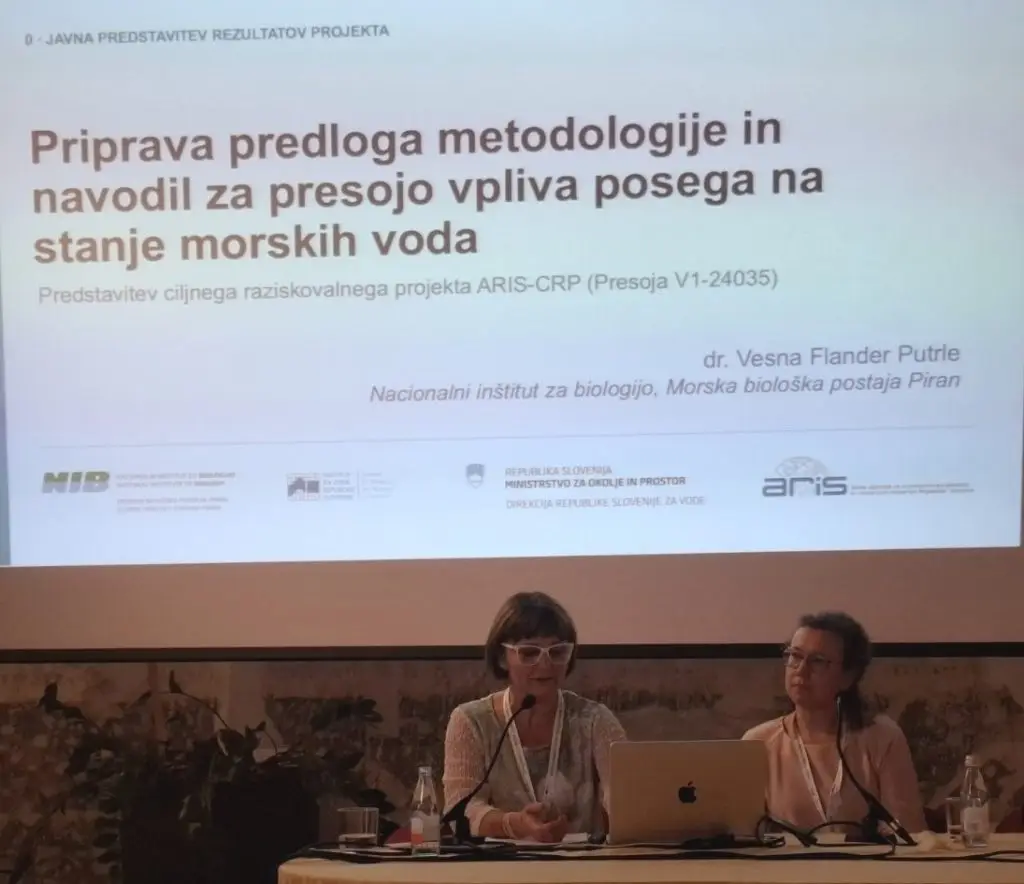
The project developed a methodology for one segment of the assessment of planned interventions, based on the requirements of the Marine Strategy Framework Directive (MSFD). The methodology does not constitute a full impact assessment and does not replace other statutory procedures; rather, it complements them with a systematic evaluation of impacts for each descriptor of marine environmental quality. It makes it possible to assess whether an intervention could cause a deterioration in the status of marine waters or hinder the achievement or maintenance of their good environmental status. It is complemented by possible mitigation measures and proposals for monitoring and supervision.
The planning and assessment of interventions must also take into account the Maritime Spatial Plan of Slovenia, which defines the areas of different sea uses and shows them in its graphic part. To conserve and enhance biodiversity and ensure the sustainable use of the marine environment, particular attention must be paid to blue or ecological corridors. Interventions and activities in these areas must not interrupt the transfer of matter and energy or the migration routes of organisms. This applies not only within the Slovenian sea but also across borders, at the level of the Gulf of Trieste, the northern Adriatic and the Adriatic Sea as a whole.
The project results provide an important expert basis for integrating MSFD requirements into broader planning and impact assessment procedures, and for better balancing development needs with the long-term protection of the Slovenian sea.