
On Monday at the end of August 2026, at the 64th International Agricultural and Food Fair AGRA in Gornja Radgona, Dr Tine Bizjak of the Institute for Water of the Republic of Slovenia (IzVRS), together with project partners from the Marine Biology Station Piran of the National Institute of Biology (MBP NIB), presented the findings of the targeted research project “Impact of Environmental Stress on the Health and Growth of Shellfish and Improvements to Farming Practices in Light of Microplastics and Climate Change”. Shellfish farming is an important part of Slovenian aquaculture. Since 2012, the quantity of farmed mussels in Slovenia has exceeded the quantity of fish caught. The main farmed species is the Mediterranean mussel (Mytilus galloprovincialis), whose farming faces new challenges due to changing environmental conditions.
In the past, the activity was affected mainly by occasional blooms of toxic algae and by the limited space suitable for shellfish farming. In recent years, the key factors affecting production have also included predation, especially by gilthead seabream, the presence of parasites such as flatworms, and stress caused by high sea temperatures.
The project also identified opportunities for the further development of Slovenian shellfish farming. These include better knowledge transfer, the introduction of innovations, the strengthening of expertise and training, and greater diversification of activities.
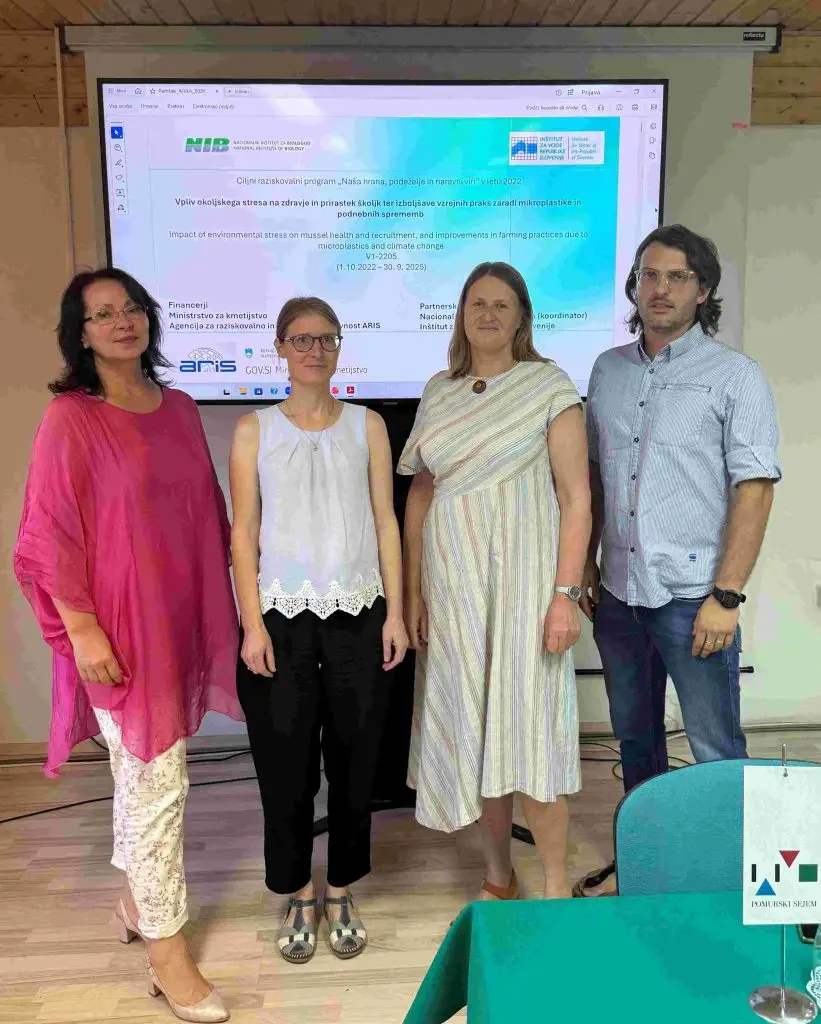
From left to right: Dr Bety Breznik (Ministry of Agriculture), Dr Manca Kovač Viršek, Dr Andreja Ramšak (NIB), Dr Tine Bizjak (IzVRS).
An important part of the research focused on microplastics. Mussels are a suitable bioindicator of marine pollution, as they can retain microplastic particles for longer periods. The analyses did not show a clear link between the pollution of water and sediment in the shellfish farming areas and the amount of microplastics found in the mussels. The results thus highlight the complexity of the effects of microplastics and other environmental factors on marine organisms.
The findings presented provide an important basis for further research and for drawing up recommendations for adapting farming practices. Linking research knowledge with the practical needs of the sector can make an important contribution to preserving and sustainably developing shellfish farming in the Slovenian sea, even under changing climate conditions.