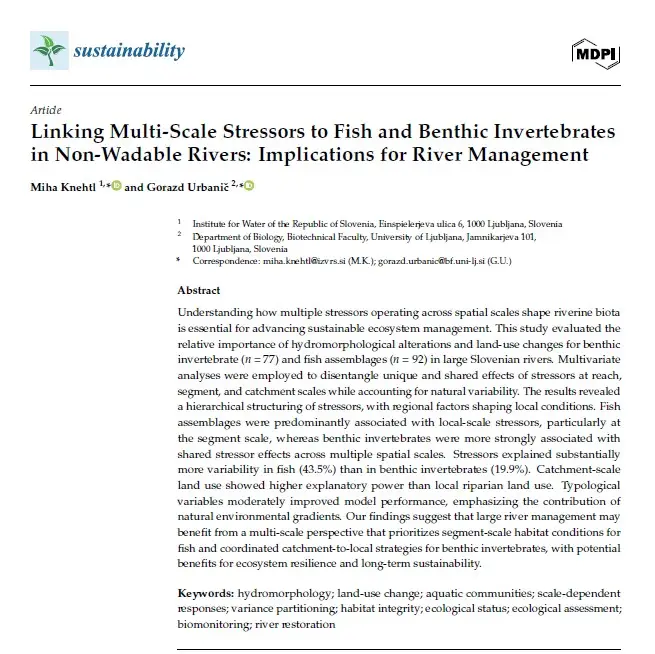
A study published in the scientific journal Sustainability examined how human interventions in the river channel and banks (hydromorphological alterations) and land use are related to the composition of fish and benthic invertebrate communities in large Slovenian rivers. The study covered the Drava, Mura, Sava, Ljubljanica, Krka and Kolpa rivers. Particular attention was paid to determining the importance of pressures at different spatial scales, from individual river reaches to entire river catchments.
The results showed that fish and benthic invertebrate communities respond differently to pressures at individual spatial scales. The composition of fish communities was more strongly related to local pressures, especially at the scale of longer river segments, whereas benthic invertebrate communities were more closely linked to the combined effect of pressures across multiple spatial scales. The pressures considered explained a substantially larger share of the variability in fish communities (43.5%) than in benthic invertebrate communities (19.9%). We also found that land use at the scale of the entire catchment was more important in explaining the composition of both communities than land use in the immediate vicinity of the river.
Effective management and restoration of large rivers therefore requires not only identifying the key pressures but also understanding the spatial scale at which they operate. The findings highlight the importance of an integrated approach to river management that links the improvement of habitat conditions in individual river reaches with measures at the scale of the entire catchment. Such an approach can contribute to more effective planning of measures, improved ecological status and the long-term conservation of river ecosystems.
Published article: Knehtl, M. and Urbanič, G. (2026). Linking Multi-Scale Stressors to Fish and Benthic Invertebrates in Non-Wadable Rivers: Implications for River Management. Sustainability, 18, 8613.
https://doi.org/10.3390/su18178613